Writing: Using Imperfection to Make Fiction Feel Believable

Everything we experience will face the forces of failure, breakage, and decay. Your make-believe elements should be the same. Their imperfections can make them feel real and create the suspension of disbelief in the reader.

For the past few weeks, I’ve been writing a series of posts about writing speculative fiction, including fantasy, science fiction, steampunk, comic books, paranormal, and horror. (For the full list, click here or on the category called “Making Make-Believe Believable.”) This week, we are taking a closer look at the second rule for making readers suspend their disbelief and buy into our story’s make-believe elements: Rule #2—Make Your Make-Believe Feel Believable. We will be discussing these four techniques:

  • Use of sensory details
  • Creating imperfection
  • Relying on character reactions
  • The use of make-believe in everyday life

Today we will concentrate on using imperfection to make your make-believe elements feel real.

Our world is imperfect. We live in a world of failure, breakage, and decay. These things make life difficult for those of us living in this world. For authors, however, these things can actually make our lives easier for two reasons:

  • All stories need conflict and tension. Failure, breakage, and decay bring tension into stories.
  • Failure, breakage, and decay can bring a dose of reality into our make-believe elements. They make our make-believe feel believable.

Let’s analyze these three elements and how we can use them to create suspension of disbelief.

Failure: I love sports statistics. They are proof that even the best of us fail at what we are good at. For example, Derek Jeter’s on base percentage for 2012 was .379. Translation: When Derek Jeter stepped up to the plate in 2012, he had a 62% chance of making an out—of failing to do his job. NFL quarterbacks have it a bit easier. As of 2012, Drew Brees—one of the best quarterbacks playing in the NFL—has a lifetime pass completion percentage of 65.7%. This means every time he throws the ball, he has a 34.3% chance of missing his target. And these two gentlemen are some of the best in their respective sports!

Your characters need to fail at their ability to use make-believe elements on occasion. If Harry Potter has to struggle with his patronus charm, your character has to struggle with something as well—especially under pressure. Not only will it create tension within your story, but it will also make your make-believe elements feel real. (NOTE: some of your characters’ make-believe skills include the ability to recall knowledge about make-believe elements.)

Here are a few concepts to keep in mind regarding failure:

  • If your character has learned a new skill, his potential for failure is greater.
  • Pressure increases your character’s potential for failure. This is true for both physical skills and the ability to recall and apply information. Pressure also creates changes in your characters’ physiology, such as sweaty palms and butterflies in the stomach. Make sure to describe these things.
  • The more humans involved, the greater the potential for failure. If a master plan involves five people in five different places, each executing their role perfectly, you might be facing a high chance of failure.
  • The less often a character has used a skill or recalled knowledge, the greater the potential for failure. Create more tension by challenging your characters with needing to recall little used skills.
  • Actions and skills that a character performs too much can create overconfidence and therefore mistakes. Your characters might not pay attention to something they do all the time.
  • Failure includes loss. Nothing is more frustrating than when a necessary item is lost. Torture your characters (and readers) with this at will.

Breakage: Everything in this world breaks eventually. Your make-believe elements need to break as well—especially your technology (or “magic technology” in fantasy).

Here are a few things to keep in mind when it comes to breakage:

  • The newest, “beta” forms of technology will be more prone to issues and bugs. Think of how many new updates Windows has to develop right after they come out with a new operating system. Magical items might work the same way. If your dwarf develops something new, it might not work properly, and he might need to take it back to the workshop.
  • The more complex and/or intricate the system, the higher the potential for breakage/failure. My home laptop rarely crashes and always communicates with the printer. The same can never be said for a computer that exists on huge network. This applies to all types of machinery as well as magic. If your character has developed a magical spell that has several steps and ingredients, the chances of mistakes are much greater.
  • Combining items from separate systems increases the potential for problems. For instance, in the office I worked in, our marketing guy used a Mac and everyone else used a PC. The moment we tried to hook his Mac up to the network, bad things happened. The parts for each computer didn’t fit together correctly, either.
  • The more delicate the parts, the greater the chance of breakage/failure. If your steampunk flying contraption is papier-mâché and held together with rainbow-colored tissue ribbons, your character might encounter some issues during flight.
  • The more people involved with making something work, the higher the chances of breakage/failure. See above.
  • If you want to know how to break things, you will need to know how they work to begin with. This means you will have do to a bit of research—even if your technology is science fiction and doesn’t really exist. You still need to know the concept of how it works so you can break it.

Decay: We live in a world of rust, rot, and decay. Your world is not brand new. It’s used. Make sure you show it. When Luke Skywalker first saw the Millennium Falcon, his first words were: “What a piece of junk!” The Millennium Falcon may have had it where it counts, but it suffered from decay just as everything else does.

Here are a few things to think about regarding decay:

  • Your environment affects the rate of decay. If your characters live in a world full of acid rain, think about its effects on stone and metal. If your environment is moist, it will affect items differently than a dry environment.
  • How often an item is used affects its rate of decay. An SUV owned by a contractor will look older and more used than an SUV owned by someone who works at a law firm.
  • Likewise, lack of human involvement can leave something in a state of disrepair. A manicured lawn looks much neater and newer than a lawn ignored by its owner (or a lawn without an owner).
  • Your worlds have a history. This history has decayed. You should have older homes, buildings, and monuments from your world’s history, which need to be decayed and old-feeling. These things give life to your world, and they make it seem real.
  • Study what makes something appear and broken decayed. Weeds, mold, rust, fungus, vines, and cracks are all signs of age and non-use.

What to take from this: Imperfection makes your make-believe elements feel real. You can create imperfection using failure, breakage, and decay. The good news: all of these elements create conflict and tension, which is a must for all stories.

Mainstream Writers: Your story takes place here on earth with humans as your characters. Failure is not only an option, it is a must! If everything in your world works perfectly, then you are the one writing the fantasy.

Fantasy novelist M. B. Weston is the author of The Elysian Chronicles, a fantasy series about guardian angel warfare and treason. Weston speaks to children, teens, and adults about writing and the process of getting published. For more information on M. B. Weston, visit www.mbweston.com. Find out more about The Elysian Chronicles at www.elysianchronicles.com.

Speculative Writers: Failure, breakage, and decay should not only affect your make-believable elements, but also your believable elements.

Posted in The World of Writing, Writing Believable Make-Believe | Tagged , , , , , , , , , , , , , , , , , , , , | 2 Comments

Writing: Make Fiction Feel Believable With Sensory Details

Sensory details can make the unbelievable elements in your story feel real. The trick is making sure you, as the author, know how your make-believe elements feel to begin with.

In other words, sometimes this (below) is a necessary part of good writing:

For the past few weeks, I’ve been writing a series of posts about writing speculative fiction, including fantasy, science fiction, steampunk, comic books, paranormal, and horror. (For the full list, click here or on the category called “Making Make-Believe Believable.”) This week, we are taking a closer look at the second rule for making readers suspend their disbelief and buy into our story’s make-believe elements: Rule #2—Make Your Make-Believe Feel Believable. We will be discussing these four techniques:

  • Use of sensory details
  • Creating imperfection
  • Relying on character reactions
  • The use of make-believe in everyday life

Today, we will focus on the use of sensory details.

A few weeks ago, I wrote a post about how to use sensory details to surround your make-believe elements with believable elements. In that post, we focused on using sensory details to describe things that were already believable and familiar to your reader. In this post, we will concentrate on using sensory details to describe your make-believe elements.

Sensory details are the most important tool you can use when it comes to suspending disbelief in your reader. If your reader can feel your world with all five senses (sight, smell, touch, taste, sound), he will be much more likely to play along with you and pretend it’s real.

As mentioned in yesterday’s post, this requires you to:

“Get into” your own world. This means you are going to have to use your imagination and play pretend like you did when you were five. I literally sit at my computer, close my eyes, and imagine myself in the world. (Yes, this looks very silly if I’m in a public coffee shop.)

“Get into” your characters’ heads. (If that sounds weird to you, tell yourself you are channeling your characters. It’s the same thing.) Put yourself directly in his, her, or its shoes and look at the world from your character’s point of view. What does your character hear? Taste? Feel? See? Smell? Believe it or not, I do this exercise for every scene I write no matter what genre I’m writing. For the purposes of this post, make sure to include sensory details on the foreign or make-believe items your reader will encounter. How does the breastplate feel on your character? What about chainmail? Is your steampunk character struggling with her corset? (I know mine does.) If you write horror and your character is buried alive, what sensory details will your character encounter that your reader might not be familiar with (and how can you use them to create horror)?

Put ample description into your make-believe elements, especially regarding how they work. Pretend you have a character who jumps on a skateboard that hovers in the air instead of using wheels. (Think of Back to the Future II.) Mentioning that you character uses such a skateboard is one thing. But think of how describing what your character felt when he uses the skateboard would affect your reader. What if you threw in things like the gentle movement when he first steps on it or how difficult it is to learn to turn? Do that, and your reader will be riding the skateboard with your character instead of watching your character ride it.

Use this concept for all your make-believe elements. How does that new contraption feel when it’s being used? Is that horseless carriage hard to steer? What really happens when Scotty beams your character up?

Try out real world examples that can help you describe your make-believe elements: Here are a few things I have done in order to help me better describe my make-believe elements:

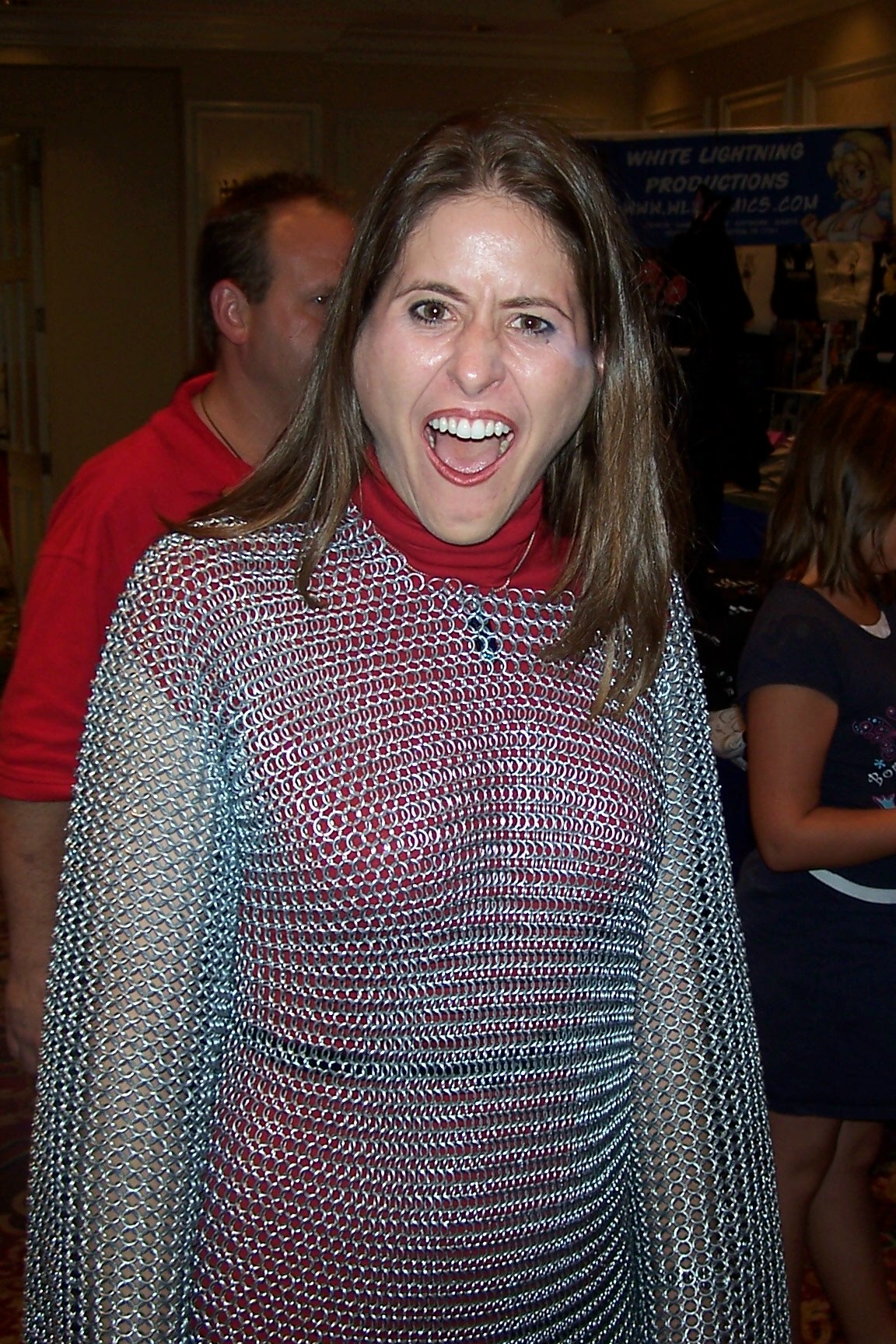
  • Tried on chainmail & armor: My characters wear armor. I never have. Therefore, when someone from the SCA was kind enough to let me try on his armor and chainmail (see below), I jumped at the chance. Feeling these things help me better understand my characters.

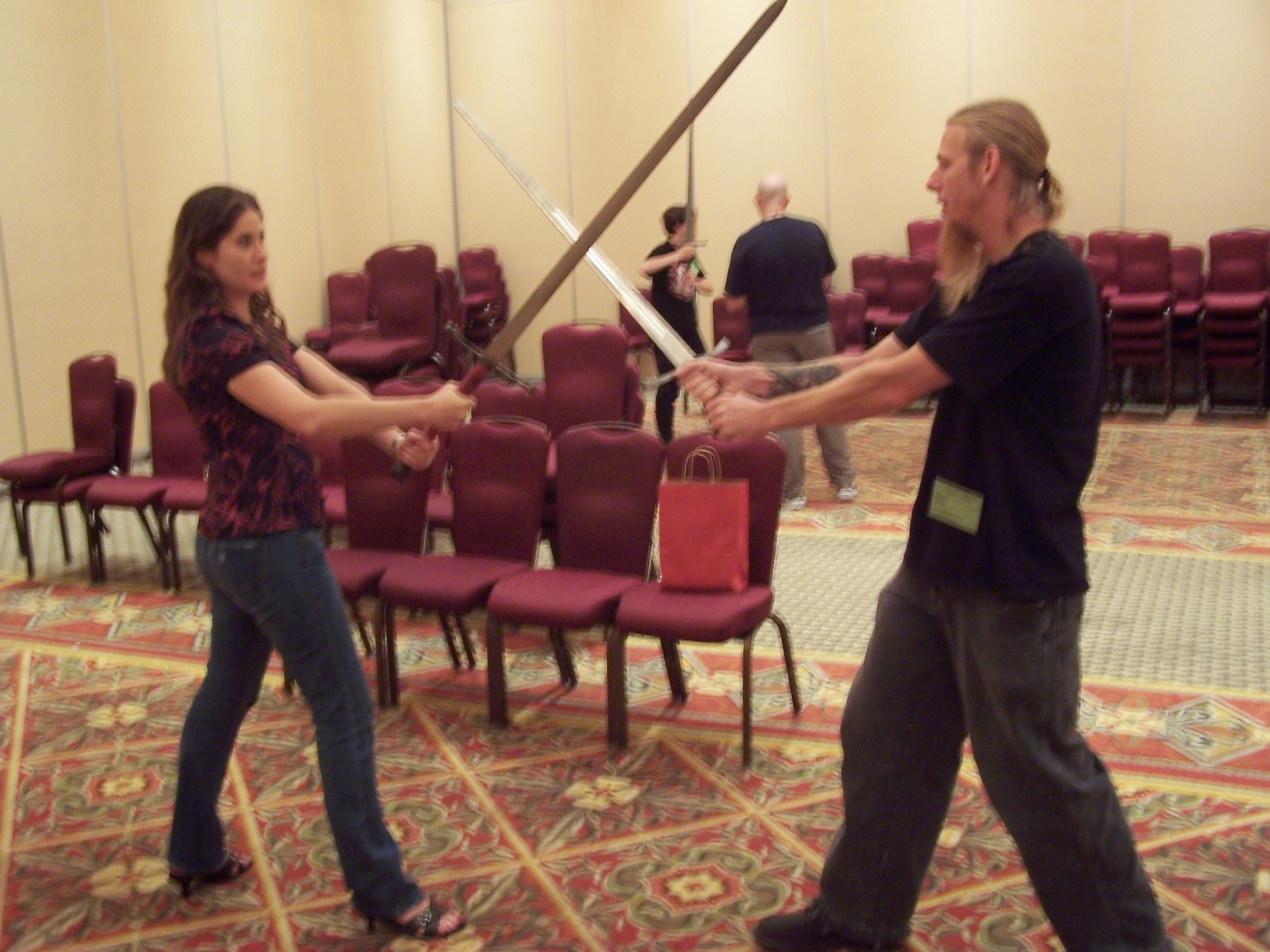
  • Taken sword classes: Real swords are heavy and unwieldy. If my characters are fighting in battle, they are going to become fatigued. Knowing how a sword feels helps my writing.

  • Paid attention when riding on a speedboat: My characters are angels, and they fly. I need to know what the wind feels like on their faces, and at what speeds

A little real-world experimenting and putting yourself into your characters’ heads will also give you an added bonus: You will discover flaws and fixes in your make-believe elements. Here are a few things that I changed or added because I imagined myself in my character’s head or did some experimenting:

  • In A Prophecy Forgotten, my character, Gabriella, jumps into a river to save the boy she is guarding. My experiences with SCUBA diving helped me realize that she would drown in the river if she didn’t take her armor off first.
  • In the same book, my character, Davian, is drenched and freezing. An advance reader read the scene and asked, “Why don’t you have Davian wrap his wings himself he gets cold?” Hence, “He folded his wings around his body and leaned against Boronan, hoping to absorb some of the unicorn’s body heat before he slipped his breastplate back on.”
  • Again, in the same book, my character, Zephor, comes to an alarming realization. I figured goose bumps would affect more than just an angel’s skin, so I wrote this sentence: “The feathers in Zephor’s wings stood straight up and goose bumps ran down his arms and legs.”
  • This works with everyday description as well. I jog in the mornings, and it can be damp. When I finish jogging, I’m covered with sweat and dew. My character, Alexor, is riding a unicorn through mist. I wanted to make it feel real, so I added, “Every part of Alexor’s uniform felt damp, and beads of dew dripped off his helmet onto his nose.” I would not have known to do that unless I jogged through mist and put myself in Alexor’s head.

What to take from this: Use sensory details about your make-believe elements so your reader will not only buy into your make-believe, but also fell like he is part of the story instead of just watching it. Use your imagination to get into your world and your characters’ heads so you can pull out details you would otherwise ignore.

Mainstream Writers: Make sure to get into your characters’ heads in each scene in order to bring it alive for the reader and discover flaws and fixes in your story.

Speculative Writers: Take opportunities to get real world experience that relates to your make-believe elements. This will help you bring your story to life!

Fantasy novelist M. B. Weston is the author of The Elysian Chronicles, a fantasy series about guardian angel warfare and treason. Weston speaks to children, teens, and adults about writing and the process of getting published. For more information on M. B. Weston, visit www.mbweston.com. Find out more about The Elysian Chronicles at www.elysianchronicles.com.

Posted in Description, The World of Writing, Writing Believable Make-Believe | Tagged , , , , , , , , , , , , , , , , | 6 Comments

Writing: Make Your Make-Believe Elements Feel Believable

Getting your reader to suspend disbelief requires you to make your make-believe elements feel real. Fortunately, you have several techniques at your fingertips, which we will be discussing this week.

It’s October! Tis the season for walking in brisk, cool weather, taking hay rides, and enjoying fall leaves. (If you live in southwest Florida like I do, tis the season for cursing the heat, slapping mosquitoes on the hay rides, and decorating your home with autumn garland because that’s the only orange, yellow, and red you’re going to get.) It’s also the season for Halloween and the all-too-familiar community haunted house. When I was young, our community Jaycee’s group set up their annual Haunted Forest a few streets down from me as a fundraiser. Every October, thousands of people would line up—and pay—to allow someone lead them through the dark woods where local young adults dressed up in frightening costumes would try to scare them to death. I could hear the patrons’ screams from my house over a mile away. These haunted forests/houses get people to suspend their disbelief because they make the make-believe elements feel real. People aren’t watching The Texas Chainsaw Massacre. They are standing five feet away from someone in a hockey mask holding a chain saw. It feels real! And they scream.

We can apply this to writing. Our job as authors is to make the make-believe part of our stories feel as real as possible.

NOTE: If you’ve just discovered this blog, I’ve been writing a series of posts about writing speculative fiction, including fantasy, science fiction, steampunk, comic books, paranormal, and horror. (For the full list, click here or on the category called “Making Make-Believe Believable.”) Over the past few weeks, we’ve been discussing the first rule for making your readers suspend their disbelief and buy into your story’s make-believe elements: Rule #1—Surround Make-Believe with the Believable.

This week, we are going to concentrate on the next rule:

Rule #2—Make Your Make-Believe Feel Believable.

In an earlier post about establishing a realistic setting (click here to read), I quickly mentioned that when I read a story, I begin to see the story’s movie playing in my head. Many of us do this. I believe that what the reader imagines when he reads is far more real and experiential than an actual movie. Reading is book instead of watching the movie is like walking through the Jaycee’s Haunted Fores instead of watching the Texas Chainsaw Massacre. The reader is there, within the story, standing right next to the characters. When I read The Lord of the Rings trilogy, I wasn’t just watching a movie in a theater. I was a member of the fellowship of the ring—a silent, invisible member, but I felt like I was right there.

A great way to help your readers suspend disbelief is to slip the make-believe elements of your story into the movie they are playing in their heads without creating any glitches that make them stop and think, “Wait. What?” Your reader should see the dark forest, the moon shining through the leafless branches on a clear night, the twisted shadows, the caw of a crow, the soft soil under the ground, the frightened characters, the witch flying around on a broomstick—and not stop the movie to wonder about the believability of the witch. You can do that by making the witch feel real.

Her are a few concepts to think about as we discuss these techniques over the next week:

  • Your make-believe elements should operate the same way as your believable elements. To the characters who use them on a daily basis, they should feel natural and familiar. They should make sense.
  • You must learn to put yourself into your characters’ heads and also into their world. This requires imagination. It means you often will need to sit back, close your eyes, and be there. If you want your readers to be there, you’ve got to be there too. Get into the world you’ve made. Turn on your eyes, ears, nose, sense of touch, and taste buds. Work with the weapons and technology you’ve created. Is it practical? Does it make sense? Does it feel familiar to you?

What to take from this: You want to introduce your make-believe elements in such a way that they feel believable, natural, and familiar, and you want to do it without stopping the movie that is playing in your reader’s head. You want to develop a practice of getting into your own world so you can better explain it to your reader.

Mainstream Writers: Unless your readers are obsessively well-traveled, you have to do the same thing as speculative writers here. Your real life worlds need to feel just as real and alive as make-believe worlds because chances are, your reader hasn’t been to the place you are writing about.

Speculative Writers: Start thinking about the stories you’ve read where make-believe things felt real. Ask yourself what the author did to make you feel that way.

The rest of this week, we will be discussing these techniques that make make-believe feel believable:

  • Use of sensory details
  • Creating imperfection
  • Relying on character reactions
  • The use of make-believe in everyday life

See you all tomorrow!

Fantasy novelist M. B. Weston is the author of The Elysian Chronicles, a fantasy series about guardian angel warfare and treason. Weston speaks to children, teens, and adults about writing and the process of getting published. For more information on M. B. Weston, visit www.mbweston.com. Find out more about The Elysian Chronicles at www.elysianchronicles.com.

Posted in The World of Writing, Writing Believable Make-Believe | Tagged , , , , , , , , , , , , , , , , | 2 Comments

Sample Sunday: Out of the Shadows–Chapter 25


For Sample Sunday, I figured I would post a sample of the 2nd novel in my Elysian Chronicles series, Out of the Shadows. This chapter takes place at the United States Naval Academy where one of my main characters, Tommy O’Connor, attends college. If you aren’t familiar with Naval Academy culture, during Army/Navy week, plebes (USNA freshmen) prank upperclassmen. No, I didn’t come up with this prank myself. I did a few interviews with Naval Academy graduates.

Bear in mind that this book takes place ten years in the future when the world is on the brink of World War III. Red V-Day doesn’t actually exist in real life, and the two teams still play against each other in a neutral stadium.

Enjoy!

(NOTE: This is not the complete chapter, mainly because I didn’t want to give away what the message in the window actually was…)

Chapter Twenty-Five: The Message in the Window

The Army/Navy football game, held during the first week in December, showcased one of the most intense and historic college football rivalries in United States history. Before Red V-Day, the Military Institute at West Point and the Naval Academy played against each other at a bigger, neutral stadium—usually the home of either the Washington Redskins or the Philadelphia Eagles. As terrorist attacks increased after Red V-Day, however, the military decided that herding the future officers of both the Army and Navy, as well as many current officers, into one stadium was militarily impractical, so they reverted to holding the games at the schools’ stadiums.

The week before the Army/Navy game included intense “spirit-building” brigade activities, including making plebes drink a Beat Army—a semi-liquid concoction made with anything the upperclassmen could find in King Hall (mustard and ketchup being two of the least offensive ingredients). That Tuesday, Tom and Marco waited for Jake, who had returned to the Academy, to finish his chemistry class.

Marco glanced ahead, where Van walked toward them. “O’Tool alert,” he whispered. “Look lively, laddy.”

Van eyed the two of them. “Straighten your gig-line, O’Connor.”

“Yes, sir,” said Tom. He rearranged his shirt, making the buttons line up with the end of his belt and the overlap of his fly. “Like the world’s going to blow up if my gig-line’s out of whack,” he muttered once Van left.

“Wow,” said Marco. “You’re testy.”

“And your gig line is more crooked than mine,” snapped Tom.

Jake finally emerged from his class, and Marco said, “You took forever.”

“I had to talk to the professor,” said Jake. “You know, get all my homework and make sure I understand what’s going on. What’s up?”

“I know you’ve got a lot of homework, but Batelli and I need you to meet us in our room tonight,” said Tom. He winked and walked away before Jake could ask any questions.

That night, the upperclassmen, including Van and Collins, left for town liberty. Tom, Marco, and Jake convened in Tom’s room. Jake kept lookout while Tom climbed on his bunk bed and removed one of the ceiling tiles. Inside, he had hidden five plastic soda bottles in the rafters. He handed the bottles, one at a time, to Marco.

Don’t open them until I tell you to,” Tom warned.

“What’s in them?” asked Marco.

“Some of the extra crab juice and meat from October,” said Tom.

Marco grimaced.

Jake inspected the contents of one of the bottles. “There’s, like, stuff growing in here.”

Tom grinned. “Yep.” He pulled out two rakes and handed them to Marco. He replaced the ceiling tiles and hopped to the floor. “Batelli and I did a little bit of Yard maintenance while you were out sick, Smithy. Let’s go.”

The three of them walked to Lejeune Hall where Tom’s sensei, understanding the nuances of Army/Navy week, had allowed him to store fifteen bags of leaves. They took the leaves and soda bottles to Van and Collins’s room. Marco opened Van’s closet and took the cap off one of the bottles. He gagged and almost dropped it. “That’s foul!” he whispered, then set the bottle on the closet floor and shut the door.

Tom took a deep breath before he opened a bottle, deposited it on the floor of Collins’s closet, shut the door, and exhaled. “Ugh. I can still smell it.”

Jake leaned the two rakes against the back wall. To one, he taped a piece of white paper that said Plebes 1, Tools 0. To the other, he taped one that said BEAT ARMY, SIR!

Meanwhile, Tom and Marco hid the remaining soda bottles in the bathroom tub and behind both computer monitors. They emptied the bags of leaves and filled the room knee deep.

“One more bag,” said Tom. “I’ve got it. You two get going!” He opened the final bag of leaves and emptied it when suddenly his skin prickled. He dropped the half-empty bag in panic and looked around.

Something was in the room with him.

On Collins’s desk, a notebook flew open on its own, and a pencil levitated in the air and scrawled on the notebook paper, WATCHING, WATCHING, WATCHING. WE’RE WATCHING YOU LIT—

Tom waded through the leaves, yanked the pencil away from whatever held it, tore off the piece of paper, and slammed the notebook shut.

Leaves flew up in the air, swirling around him in a whirlwind.

…to be continued in Out of the Shadows.

Fantasy novelist M. B. Weston is the author of The Elysian Chronicles, a fantasy series about guardian angel warfare and treason. Weston speaks to children, teens, and adults about writing and the process of getting published. For more information on M. B. Weston, visit www.mbweston.com. Find out more about The Elysian Chronicles at www.elysianchronicles.com.


Posted in Books & Works by M. B. Weston, The Elysian Chronicles | Tagged , , , , , , , , , , , , , | 1 Comment

Today’s Writing Muse: The Swamp

Swamps make such great settings. The plants look odd. (Seriously, look at those tree roots!) The potential for gross out moments escalates with murky water and the who-knows-whats-in-it muck under the water. Quite a few of the inhabitants bite.

You may have an idea for a great setting, such as a swamp, but you may lack a story. If this occurs, ask yourself a few questions to stimulate creativity:

  • Why is my character here? If your setting is a swamp, your character needs a pretty good reason to be there. She may be hunting crawfish. He may be trying to get rid of a body. Someone may have lost a bet.
  • How is my character going to get out of here? Is a boat available? (You can always break the motor, you know.) Will she have to wade back?
  • What obstacles stand in my character’s way? Swamps give you so many options to choose from: alligators, lack of compass, mosquitoes, poisonous snakes.

Notice that these questions focus on things that can create conflict. Conflict is the essence of a story. Focusing on questions that lead to conflict can help you think up a good story based on a cool setting.

There’s your muse! Go!

Fantasy novelist M. B. Weston is the author of The Elysian Chronicles, a fantasy series about guardian angel warfare and treason. Weston speaks to children, teens, and adults about writing and the process of getting published. For more information on M. B. Weston, visit www.mbweston.com. Find out more about The Elysian Chronicles at www.elysianchronicles.com.

Posted in The Muse, Inspiration & Story Ideas, The World of Writing | Tagged , , , , , , , , , | Leave a comment

Writing Technique: Star Wars–an Example of How to Break the Rules

Almost any writing rule can be broken, as long as the author 1) earns the right to break it and 2) executes properly.

For the past few weeks, we’ve been discussing how to create the suspension of disbelief in readers by surrounding our make-believe elements with believable elements (click here to read the blog post). Today, we are going to discuss how you can break this rule and get away with it using George Lucas’s Star Wars: A New Hope as an example.

Think of the opening scene in Star Wars: First we see a tiny spaceship being chased by a colossal space ship. Then, we see some men in weird helmets start shooting lasers at some…dudes in white armor. All the humans die or retreat. Then, we see this masked guy, who dressed all in black—with a cape—and sounds like he is breathing through SCUBA gear, enter the scene and step over the dead people, including his own. Oh yeah, and the female lead looked like she was wearing hair-wrapped bagels over each ear.

I ask you: What part of this seems believable?

Lucas didn’t even bother to surround his make-believe elements with believable elements or prep the reader in his opening scene, and yet this scene captivated the audience. Millions of people, who by the way don’t love science fiction, love Star Wars. This shouldn’t make sense, should it?

Lucas broke the writing rules, and it worked because he earned the right to break them and executed properly. Here’s how he did it:

He used mythological archetypes. Lucas studied myths, legends, and The Hero’s Journey. We can relate to his characters because we’ve seen models of them before in other stories. Star Wars is actually an epic fantasy wrapped in a science fiction shell.

He had great characters and great character development. Han, Luke, and Leia had depth and individual personalities. They were well-developed. They didn’t fit clichés. Think about this. The hero, Luke, whines. The princess, Leia, shoots a couple of storm troopers the moment we first see her. The sidekick/friend is an anti-hero smuggler, in it for himself and the money. (Come on, admit it. Your heart still jumps when Han Solo comes back at the end of the movie. You know it does!)

He used epic conflicts. A small band of rebels fighting for freedom from an oppressive dictator is a conflict you can find throughout both history and all genres of literature.

He used a great soundtrack. In a world of dissonant soundtracks that sounded more like that of Planet of the Apes, Lucas gave us John Williams. Writers can’t use sound tracks, but we can use sensory details and description to enhance our readers’ emotions. I discussed this in a series of blog posts on description and creating a main impression a few months ago:

He used great special effects no one had ever seen. Again, writers don’t get to use special effects, but we can, in a sense, create the need for them by creating amazing, new concepts within our books. Think “shock and awe.” Be creative. Break the mold.

His world had back story, which helped it feel real. Obi-Wan mentions the Clone Wars to Luke. Luke knows exactly what the Clone Wars were, and the fact that Obi-Wan fought in them impressed him. Likewise, Han Solo mentions that the Millennium Falcon is “the ship that made the Kessel Run in less than twelve parsecs,” as though Luke would know what he meant. Heck, Luke used to bull’s-eye womp rats in his T-16 back home. (I may not know what a womp rat is, but I’m sure it’s not much bigger than two meters.) Little things like this make the world feel real.

What we saw visually made sense, even if it was make-believe. Luke didn’t traverse the desert in some odd contraption we had never seen before. He used something that looked like a beat-up car that hovered. His speeder made sense. (Notice Lucas saved the AT-ATs for Empire Strikes Back.) The same can be said for other items, such as blasters, armor, and light sabers. They looked normal—not like something Dr. Emmett Brown would wear on his head to read someone’s thoughts.

The story appealed to people on a deep level. This is the magic of stories, which I will in much more detail later. For now, remember that humans desire adventure, companionship, and the ability to make a difference. You can help your readers meet these desires by allowing them to live vicariously through our characters.

He opened with an exciting, tension filled scene. At the end of the first scene, we know who the bad guys are and who the good guys are. We know the bad guys seem to have the advantage. We also know the chick in those sweet bagel buns is someone you don’t want to mess with, and she’s a good guy.

What to take from this: You can break the rules, but make sure to do it properly. Study the works of successful storytellers who broke the rules and got away with it.

Mainstream writers: Open your story with something that hooks the reader. It doesn’t have to be a space battle, but it needs to be something. Grab your readers head on and don’t let them look back.

Speculative writers: Yes, you can break the rules and hit your audience with some hard-core make-believe, but make sure you execute!

If you are new to this blog, I’ve been writing a series of posts about writing speculative fiction, including fantasy, science fiction, steampunk, comic books, paranormal, and horror. For the full list, click here or on the category called “Making Make-Believe Believable.” Thanks for stopping by!

Fantasy novelist M. B. Weston is the author of The Elysian Chronicles, a fantasy series about guardian angel warfare and treason. Weston speaks to children, teens, and adults about writing and the process of getting published. For more information on M. B. Weston, visit www.mbweston.com. Find out more about The Elysian Chronicles at www.elysianchronicles.com.

Posted in The World of Writing, Writing Believable Make-Believe | Tagged , , , , , , , , , , , , , , , , , , , , , , , , , | 3 Comments

Writing Technique: Prep the Reader for Your Plot Twist and/or Make-Believe Element

Using a few techniques to prepare your reader for you plot twist or your make-believe element can draw your reader into your story, increase suspense, and create a huge emotional reaction in your reader.

I was probably three or four the first time I went to see Santa Claus. I remember looking up at this huge guy with a biker beard who was dressed in bright red and wanted me to sit on his lap. It did not go well. I freaked out and burst into tears. My mom had not prepped my preschool self appropriately for Santa Claus. Had I been told that Santa was the nice man responsible for filling my Christmas wish list, I might have been much more willing to sit in the guy’s lap.

The second time I visited Santa, I had experienced a Christmas where he had left me presents. I had seen Christmas movies about Santa and Rudolf. I was fully prepared to tell Santa my Christmas desires—without bursting into tears.

Sometimes, you just can’t throw a three-year-old on Santa’s lap without explaining who Santa is. In the same way, sometimes you need to prep your audience in order to get them to suspend disbelief in your make-believe elements. Drawing the reader in and leaving clues to your make-believe element is a great way to get your audience to press the I Believe Button. It works especially well in with genres such as paranormal, urban fantasy, and crossovers that are intended to grab a larger audience.

Prepping the reader can:

  • Create suspension of disbelief. A reader who might not like speculative fiction will be more willing to suspend disbelief because the clues were laid out for him first.
  • Build suspense. Prepping the reader creates suspense. Suspense, after all, is a form of tension, and tension turns pages. The unknown is a powerful tool for writers. It creates fear in readers that you can’t create by just throwing a monster at them. On that note, remember that…
  • Cause your reader to imagine the worst possible scenario. I’ve discovered this through my readers and the questions they would ask me about what might happen in the next book. So many times, I’ve thought, “Wow, that’s pretty scary. I didn’t even consider it.” Hiding your monster, villain, or ghost from the reader’s view will give your reader the chance to imagine something worse than you can dream up. (On that note, make sure the creature (or the secret world, etc.) lives up to the hype when you finally bring it out in the open.)
  • Make your reader continue to read. Curiosity can kill cats. Curiosity can also keep your reader interested in your story. What is causing the noise in the attic upstairs? What made the crop circles in the corn field? How did the books move across the table when no one is in the house? All of us want to know what’s going on.
  • Create an intense emotional response in the reader. I still get goose bumps up and down my arms when I watch the climactic scene in Signs, even though I’ve seen it many times. When the audience finally sees how the random cups of water, the asthma, and the dying wife’s cryptic messages of “Swing away” and “Tell Grant to see” finally come together and make sense, my emotional response is far stronger than if those clues were explained right away.

How to prep your audience:

  • Leave clues throughout the story. This is tricky. You need to leave enough clues so that your end result makes sense, but not too many. You don’t want your audience to guess where you’re heading and call your story “predictable.” You want your audience to experience what I call “The double ‘Oh’ moment.” Oh #1: What your reader says—with surprise—when you reveal your secret. Oh #2 = What your reader says when he realizes the clues where there all along.
  • Use sensory details as much as possible. I cannot stress the importance of sensory details enough. Make sure your readers feel your story. It will 1) emotionally draw them in and 2) make them suspend disbelief.
  • Make sure your characters react realistically to the clues. If your clues aren’t strong enough to elicit an emotional reaction from your characters, don’t force it. Likewise, if your character should react a certain way—say, by running away from the growling noise in the basement instead going down the stairs to investigate because you need her too, your audience won’t buy it. Instead they’ll make a spoof off of it and post it on YouTube. (Worse yet, they’ll make up an excuse to create another movie in the Scary Movie series. For the love of good cinema, watch your character’s reactions!)
  • Hide your creature/villain/surprise for as long as possible. This can create terror in your reader. It can also create wonder and awe. If your surprise fantasy creature is a unicorn, your audience’s reaction to finally seeing will be stronger if you hold off on revealing it. (Ooh, this sounds like a good story. I’m so writing this.)
  • Make sure your clues are researched. I’m eventually going to write a YA novel about a werewolf. I’ve studied werewolf legends, and I’ve also researched predatory activity in Sylva, North Carolina—the story’s setting. Turns out, they have just released red wolves back into the Smokey Mountains. Guess what I’m going to be bringing up and exploiting in the story? Red wolves. Did they kill whatever my werewolves will kill? No. Will they be blamed? Yes. Will it cause controversy? Yep. Will my clues be researched? Yep.

What to take from this: If you execute it properly, you can get even non-fantasy readers to suspend disbelief in your make-believe world and enjoy your story. The key: prepping them for your make-believe elements.

Mainstream writers: You might not drop the “It was aliens” bomb on your reader, but you may have a plot twist at the end of your story. Make sure to prep your reader for your twist. The reader doesn’t need to be able to guess whodunit, but he does need to be able to reread the story and pick up on all the clues he missed the first time.

Speculative writers: Our biggest mistakes in this area will involve 1) inappropriate character reactions to our clues, 2) failure to live up to the hype we’ve created, and 3) showing the make-believe element too soon. Pay careful attention to these issues.

If you are new to this blog, I’ve been writing a series of posts about writing speculative fiction, including fantasy, science fiction, steampunk, comic books, paranormal, and horror. For the full list, click here or on the category called “Making Make-Believe Believable.” Thanks for stopping by!

Fantasy novelist M. B. Weston is the author of The Elysian Chronicles, a fantasy series about guardian angel warfare and treason. Weston speaks to children, teens, and adults about writing and the process of getting published. For more information on M. B. Weston, visit www.mbweston.com. Find out more about The Elysian Chronicles at www.elysianchronicles.com.

Posted in Plot & Structure, The World of Writing, The Writing Process, Writing Believable Make-Believe | Tagged , , , , , , , , , , , , , , , , | Leave a comment

Writing Technique: Creating Believable Worlds, Characters & Creatures

Even your make-believe worlds, characters, and creatures should still contain believable elements. Use what you know about human nature, history, economics, government, and science to make your world feel real.

Movies are full of ostentatious stunts and explosions that most people will admit are unrealistic. However, most of us in the audience don’t really care. We are willing to suspend our disbelief in Hollywood stunts because they don’t (usually) detract from the story. That, and explosions are pretty cool…

I’m not as forgiving when Hollywood messes up basic facts. For instance, in the movie, Rush Hour, a member of the LAPD has applied for the position of special agent at the FBI, but his knowledge about how the application process works is horribly wrong. (I know this because I’ve actually applied to the FBI.) Obviously, the writers didn’t do even research on the process. Simple errors like that can detract from the story and cause your readers to stop suspending their disbelief.

To surround your make-believe elements with believable elements, two things must happen:

  • You need to become an expert in a lot of subjects, especially fiction where you are creating another world.
  • You need to avoid making huge mistakes that a basic Google search will expose.

To create believable fiction, you need expertise in:

Human nature. If the characters in your novels behave contrary to your reader’s experience with human nature, he or she will have a harder time believing in your world. This requires understanding of sociology and history. History provides us with a plethora of examples of how humans behave. History also answers the “what if” questions you might have about situations you’ve created in your world.

I wrote my second novel, The Elysian Chronicles: Out of the Shadows, after Vladmir Putin finished his first stint as the president of Russia and was serving as only the prime minister. The prospect of him running for president again seemed silly to many. I disagreed, and though I didn’t actually name the Russian president Vladmir Putin in my book, I gave him the initials VP (for Vascha Polzin) in order to let savvy readers know who I meant. Guess who is president of Russia now—again? That’s right. Vladmir Putin. No, I’m not a prophet. Yes, I understand human nature, history, and Russian history.

NOTE: If your character or people group is not human, you might not be able to rely on what you know about human nature. The key to make your non-human character believable is to establish the species’ nature, and stay consistent with it. For instance, in Star Trek, Vulcans are believable because they are consistently logical. If Vulcans wavered from their nature, Star Trek’s fan base would revolt.

The Opposite Sex. If you write for both genders, you need to understand how the opposite sex actually works. If your men behave like women, or if your women behave like men, you will lose half of your audience. (If you write gender specific fiction, ignore this, but don’t be surprised if the opposite sex consistently makes fun or your characters. I mean seriously, how many women actually behave like those in comic books? And how many men act like those in romance novels?)

Economics. If you are writing fiction that takes place in the real world, you need to understand the economic system in which you are writing. If you are creating your own world, research the economic systems, both today and throughout history. Remember that history provides us with all the examples we need, and that includes economic history. Use these examples as archetypes that your reader can relate to. If your economic system differs from what we know of human nature, explain why. Don’t create a world where people freely give to each other and have no form of payment unless you first explain why they are perfect.

Government. Know how governments work. Study different forms of governments throughout history (and don’t be afraid to steal ideas from them). Your reader will be much more comfortable with the government you create if he or she can relate to it.

Science and technology. For science fiction writers, this is a must, but it’s also true for the rest of us, even mainstream writers. In this information age, you don’t have an excuse for not knowing how things work. If you mess up science, your reader will stop believing anything you present to them. Knowledge of science and technology can do a few things for you:

  • It can help you create your own forms of fantasy, steampunk, and science fiction technology. I use an encyclopedia of weapons as research when I’m trying to create fantasy weapons. It helps to know how a crossbow works if I want to tweak it.
  • It can make you look like a genius. Jules Verne. Submarine. End of illustration.

Languages. If you want to surround your make-believe world with believable elements, you need to create names, languages, and dialects that people can relate to. Here are a few tips.

  • Base languages on already existing languages: Tolkien based a lot of his elvish language on Finish.
  • Ask yourself if you really need the apostrophes and other symbols: You may be tempted to use apostrophes in your names and languages because they look “cool and fantasy-esque,” but consider how real languages work. Their symbols have a grammatical purpose. Create consistent rules for your apostrophes or eliminate them.
  • Choose character and location names that sound realistic: Creating a new world with words and names that sound silly will only make readers stop suspending their disbelief. Use a thesaurus, other languages, or Wikipedia as a starting point for your names. You can also use www.babynames.comand other such sites to find real names that aren’t as well known.
    • Good example of names: Star Wars, Episodes 4-6: Han, Luke, Leia, Obi-Wan, Chewbacca, Yoda, Lando. These names are different, but they sound like normal names.
    • Bad examples of names: Star Wars, Episodes 1-3: planet Naboo, Count Dooku. This is one of the reasons why people had a hard time accepting Lucas’s new worlds is real.

What to take from this: Do your research. Make your world logical. We live in a world powered by Google, so you have no excuse. When you show adequate knowledge on the real things, your readers will accept the make-believe ones.

Mainstream writers: Don’t have your characters apply to the FBI without knowing how the process works.

Speculative writers: To make your world, creatures, and characters believable, you need to show the reader you have knowledge of conventional concepts. You can break with convention as long as you explain it (which means you still need to have knowledge of the concepts).

If you are new to this blog, I’ve been writing a series of posts about writing speculative fiction, including fantasy, science fiction, steampunk, comic books, paranormal, and horror. For the full list, click here or on the category called “Making Make-Believe Believable.” Thanks for stopping by!

Fantasy novelist M. B. Weston is the author of The Elysian Chronicles, a fantasy series about guardian angel warfare and treason. Weston speaks to children, teens, and adults about writing and the process of getting published. For more information on M. B. Weston, visit www.mbweston.com. Find out more about The Elysian Chronicles at www.elysianchronicles.com.

Posted in Character Development, The World of Writing, Writing Believable Make-Believe | Tagged , , , , , , , , , , , , , , | 2 Comments

Writing Technique: Creating a Believable Setting

Creating a believable setting can help your readers suspend their disbelief and accept the make-believe elements in your story.

Author Lakin Konieczny (read her blog here) left a great comment on one of my blog posts, explaining how she creates suspension of disbelief by “trying to create a setting and characters that feel so real it seems like they could be your next door neighbor, then I add something supernatural or paranormal that gives it that twist as promised by genre.” Based on this comment, I figured I ought to include a post on setting. (By the way, if you write paranormal, fantasy, or horror, do be sure to check out her blog on writing.)

Imagine this: You meet con artist, John, who claims to be a financial, and he offers to invest your money. He wants to meet you for lunch.

  • Scenario 1: John drives up to meet you in a late model Mercedes Benz. His suit is tailored, his hair is immaculate, and he is sporting a Rolex. His shoes look Italian. You find out that he lives in a posh area of town.
  • Scenario 2: John drives up to meet you in a beat-up Ford Pinto from the 1980’s. He introduces himself as “Johnny.” His hair is a little bit greasy, his shirt is unbuttoned—framing the heavy gold chain around his neck, and some of his chest hair pokes through. His pants are too tight, and he is wearing flip flops. You find out through conversation that he lives on the sleazy side of town.

Which con artist is more believable?

We writers are actually than con artists trying to get people to buy into our stories, and our settings are the clothing our story wears. Your setting needs to be believable or readers will know they are being conned.

When it comes to setting, try thinking more like a movie director. Directors must create an entire stage that looks real on every level. As writers, we need to concentrate on our setting almost the same way a director must focus on his stage. We don’t need to worry about every cup and picture the way an interior decorator for the set might worry about it, but we do need to fill our setting with things that will make it believable for a few reasons.

  • Setting can show character. Even though we’ve been discussing how to write speculative fiction, we can’t neglect the importance of showing character, especially since believable characters help your reader suspend his disbelief. Your character’s neatness, decorative choices, and even the place he or she chooses to live show who he or she is—all without you having to describe it.
  • A real, grounded setting helps the reader suspend disbelief. When the setting feels real, the reader will be more willing to buy into your make-believe world.
  • Establishing a good setting makes the world come alive for your reader. When I read a well-written story, I see the movie of the story actually playing in my head. You want your reader to see more than just a white background in your story’s movie.
  • Shock and awe. Have you ever stepped into an awe-inspiring place that gave you goose bumps? Have you ever been in a place that gave you the creeps? You can create these feelings in your reader simply by establishing an appropriate setting.
  • If you’ve created a different world, you must include setting in order to help your reader feel as though he is a part of that world. If a reader doesn’t see your new world two things happen. First, he is missing out on the magic of the world you see because you haven’t described it to him. Second, he isn’t going to believe in your make-believe elements because the environment doesn’t feel believable in the first place.

How to create a good setting:

  • Include Sensory Details: A few months ago, I wrote a post about using sensory details and description in your writing. (Click here to read it.) I cannot stress how sensory details make your setting feel real.
  • Don’t neglect the surroundings. Don’t just focus on the storefront your character is standing in front of. Make sure to show a bit of the other parts of the street.
  • Remember that people are part of the setting. In movies, they’re called extras. If two characters are meeting in a restaurant, they will be surrounded by patrons and restaurant staff. Don’t forget them.
  • Clothing is important, especially if you are writing a period piece. Make sure to give a few details on clothing. Also, remember clothing’s effect on your characters. For example, if your characters are wearing armor, it’s going to get uncomfortable. Point that out.
  • Weather is important, too. Don’t forget weather, and don’t forget that it changes.

How much detail you use when describing your setting will vary depending on genre:

  • Historical fiction, new fantasy/sci-fi worlds, and steampunk require more description. First, your audience has never been to your world. Second, most readers love these genres because they want the description.
  • Urban fantasy and modern day paranormal might not require as much description when introducing the world. If I say, “Times Square” most of my readers already know what it is. I can give a few sensory details about it, but I don’t have the same difficulties that I face if I am describing a species of tree that doesn’t exist on this planet.
  • Children’s fiction and YA will require a different amount and type of description than adult fiction. Think of the differences in writing style and length of description between C.S. Lewis and J.R.R. Tolkien.

On that note, just be yourself. While it’s important to stay within genre, don’t give yourself up in order to do so. Your voice is your voice. I write with less emotion than other authors, and I prefer to let my setting and characters’ behavior show how they feel instead telling the reader. Some readers don’t like it and wish I focused more on emotion. Others love it.

What to take from this: Surround your make-believe elements with believable elements by creating a believable setting. Your setting can also 1) aid with character development and 2) add structure to the movie that the reader sees in his head when he reads your work.

Mainstream writers: You can stir up feelings of magic, awe, and fear simply by creating a good setting.

Speculative writers: Describing your setting is non-negotiable. If you feel like your characters are acting in nothing but white space, you probably need to add in a few details.

If you are new to this blog, I’ve been writing a series of posts about writing speculative fiction, including fantasy, science fiction, steampunk, comic books, paranormal, and horror. For the full list, click here or on the category called “Making Make-Believe Believable.” Thanks for stopping by!

Fantasy novelist M. B. Weston is the author of The Elysian Chronicles, a fantasy series about guardian angel warfare and treason. Weston speaks to children, teens, and adults about writing and the process of getting published. For more information on M. B. Weston, visit www.mbweston.com. Find out more about The Elysian Chronicles at www.elysianchronicles.com.

Posted in Character Development, Description, The World of Writing, Writing Believable Make-Believe | Tagged , , , , , , , , , , , , , , , , , , , , | 7 Comments

Writing Technique: Using Archetypes


Use familiar archetypes of known fantasy creatures, aliens, and paranormal beings to surround the unbelievable with the believable.

If you are new to this blog, I’ve been writing a series of posts about writing speculative fiction, including fantasy, science fiction, steampunk, comic books, paranormal, and horror. For the full list, click here or on the category called “Making Make-Believe Believable.”

For the next week or so, we will be concentrating on the first technique for helping your reader suspend disbelief: Surround the Unbelievable with the Believable. Here are a few examples of methods we can use:

Today, we will focus on the archetype example.

“What’s your book about?”

It’s usually one of the first questions someone asks an author at a book signing. Here are a few answers an author might give:

  • A girl who hunts vampires.
  • A virus that creates zombies, who try to destroy the world.
  • A detective who discovers that the serial killer terrorizing his village is a werewolf.
  • A ghost of a murder victim who haunts the house of her murder.
  • An advanced alien race that tries to take over Earth.
  • Thor, the god of thunder.
  • A scientist living in 19th century England who develops a time machine.
  • A boy who discovers he’s actually a wizard.
  • Well, it’s about this creature I made up. It’s got weird horns and the power to read the minds of its victims. It’s kind of a like a cheetah, but it can also disappear, and it’s got this really great magical ability to…

Which of these descriptions will readers least likely be willing to believe? Which of those descriptions will least likely grab you a potential buyer? The one with the unknown creature, of course.

Vampires, Zombies, werewolves, ghosts, aliens, ancient gods, and wizards are all archetypes that most readers, even mainstream readers, have heard of. They feel familiar. Although each author’s version of the archetype might be different, the reader can immediately picture what the book is about. These archetypes are so engrained in our culture that we have suspended our disbelief in them already. Using them is like cheating.

How engrained can these archetypes become in our culture? Take a look at people’s reactions to the Stephanie Meyer’s Twilight series. How many times have you heard someone say, “Real vampires don’t sparkle,” as though vampires actually exist?

If you ask me about my Elysian Chronicles series, I will use the terms angels and demons. I won’t mention that I call them cherubians and mornachts. I want the reader to feel like he can relate to my story immediately. I’ve also got a book in the lineup which will feature a berserker-type of character. Most people haven’t really heard of berserkers, unless they study Viking and Norse history. (Here’s a good description of them if you are interested.) Because of that, this book will be a harder sell to non-fantasy readers, which is one of the reasons I’m putting it on the back burner. I need to establish my audience before I throw a berserker at them.

J.K. Rowling has probably made the optimum use of archetypes in her Harry Potter series. She makes use of creatures that most of us recognize. We’ve all heard of goblins, elves, magic wands, dragons, witches riding brooms, ghosts, and centaurs. Even hippogriffs are mythological creatures. Rowling used creatures we all are familiar with, but she also did the work to make them her own. She also grabbed a large audience of mainstream fiction readers.

How to make your archetypal creature special (i.e. make it your own):

  • Give your creatures history and backstory. History and backstory not only make your creatures feel more real, but they also make them yours.
  • Establish a hierarchy of wealth/power/skills. Look at human society as an example. All cultures have a hierarchy of wealth and power. Your creatures should too.
  • Give your similar creatures differences. In The Elysian Chronicles: Out of the Shadows, I introduce gnomes and dragons into the series. I made sure to divide my gnomes into clans, and I made different races of dragons, patterning them off dragons from different cultures.
  • Earn the right to use the archetype by proving you have knowledge about them. Study the legends and folklore. Mention it certain aspects of it in your story. I did research on airships for my steampunk short story, “The Survivor,” which features an airship made by Great Britain. This particular ship would have been created long before Britain’s first airships—the R101 and R102. I called it the “HMS Phoenix, a dirigible class R10.” With that in mind…
  • Add in a few “Easter eggs” for readers who are in the know. I made sure to create a specific gnome clan that loved green, and I called them the Luchorpan clan—the root word for leprechaun. I created a clan called the Nibelung, which will be of interest to those who have studied Scandinavian folklore, as will the Mime clan.
  • If you break with tradition, make sure to explain it to the reader. If your werewolves can’t be killed with silver bullets, explain why.

Reasons to consider using archetypes:

  • The reader already knows about the archetypes, which increases his comfort levels.
  • In most cases, the reader has already suspended his disbelief regarding these archetypes.
  • It is much easier to write about something that is already known. You aren’t recreating the wheel, and you don’t have to use too many words to describe what you are talking about.

Problems with using archetypes:

  • The audience already has a preconceived opinion of them. Remember, according to a lot of people real vampires don’t sparkle. One of the difficulties I have encountered is dealing with people’s preconceived notions of angels, which are never the same. I try to explain that they are “Roman Soldiers with wings fighting monsters.”
  • It’s easy to get lazy with archetypes. Don’t write about a cookie-cutter werewolf. Don’t let your aliens look exactly like those from Roswell. Make sure your ghosts should special qualities. If you include an airship in your steampunk story, make it special. (See above.)
  • Some people just don’t like “vampire books.” Using archetypes has the potential to limit your audience. Some people might not like to read about zombies, werewolves or vampires. It’s a risk you will have to take. However, remember that some people will buy your books simply because they do feature your archetype, so don’t let it stop you from writing.

What to take from this: Our culture has already chosen to suspend its disbelief in certain archetypes. Take advantage of this! Using the archetypes will help the audience suspend its disbelief because, in a sense, you are surrounding the unbelievable with the believable.

Mainstream Writers: Consider throwing the potential of a speculative archetype into your plot. For instance, in Guy Ritchie’s Sherlock Holmes, Lord Blackwood claims to be powerful in the dark arts. While all of Blackwood’s powers are really only slight-of-hand tricks, the audience is willing to consider the Blackwood might be a wizard. Throwing in the potential of a common mythological or paranormal archetype, such as a vampire (or an alien), into your story might help move the plot forward.

Speculative Writers: Use archetypes, but don’t get lazy. Make them your own.

Fantasy novelist M. B. Weston is the author of The Elysian Chronicles, a fantasy series about guardian angel warfare and treason. Weston speaks to children, teens, and adults about writing and the process of getting published. For more information on M. B. Weston, visit www.mbweston.com. Find out more about The Elysian Chronicles at www.elysianchronicles.com.


Posted in The World of Writing, Writing Believable Make-Believe | Tagged , , , , , , , , , , , , , , , , , , , , , , , , , , , , , , , , , , , , , , , , , , , , , , , , , , , , | 8 Comments